State of the Onion
Peeling back the layers on a pivotal year in immigration enforcement.
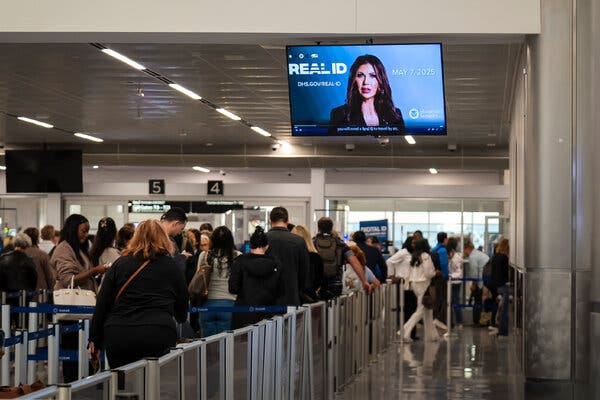 Source:“Homeland Security Secretary Recommends New Travel Ban,” The New York Times, Dec. 1, 2025
Last updated: March 31, 2026
Last Tuesday night, the 47th President of the United States delivered the first State of the Union address in American history during a government shutdown. The Department of Homeland Security has been shut down since February 14 — the third time this fiscal year — over demands for immigration enforcement reform that both parties now expect to fail.
The speech ran 108 minutes — immigration dominated, while the then forthcoming and now ongoing military confrontation with Iran got three minutes of airtime. In the gallery, the administration seated families of people killed by undocumented immigrants. Across the aisle, Democratic members brought guests and photographs of Renée Good and Alex Pretti — two U.S. citizens killed by federal immigration agents in Minneapolis last month.
The President did not mention Good or Pretti. He called for “the full and immediate restoration of funding” for DHS, and gave no indication of forthcoming reforms or the ‘de-escalation’ he had previously signaled.
I launched Jrada Immigration, P.C. shortly after the inauguration in January 2025. The timing was not accidental — I’d spent years at big law firms learning how the system operates at its best and at its worst, and every signal at the time pointed to a dramatic shift in immigration policy. Even so, I could not have predicted what has come to pass over the last 13 months.
I’ve spent most of this first year building out my practice, while tracking as many executive orders, policy memoranda, and proclamations as humanly possible. When I opened my doors, there was no travel ban in place. No blanket asylum freeze. No domestic adjudication hold triggered by country of birth. Today, nationals of a staggering 92 countries are subject to some form of restriction or immigration processing hold, asylum applicants are stuck in the mud, and the Department of State has revoked an unprecedented number of previously valid U.S. visas, often with no warning or notice to the visa holder, effectively locking Lady Liberty’s doors behind many, some after years of established presence and contributions to their respective communities.
Exemplifying the continued paralysis of a previously humming immigration system, just a month ago on January 31, 2026, the government shut down — again — over DHS funding. It reopened February 3 on a two-week stopgap, only for DHS to shut down again on February 14 when that stopgap expired. Most DHS employees have been deemed essential and are still working — without pay. Global Entry enrollment has been suspended, TSA PreCheck has been threatened, and the next fully missed paycheck is scheduled for March 12. That is the operating condition of the department deciding the cases discussed below.
The web of international travel restrictions, in particular, have morphed into Frankenstein’s travel ban, mangling even Trump-45’s bans beyond recognition. It started in June 2025 with Presidential Proclamation 10949, suspending entry for nationals of 19 countries. It expanded in December with PP 10998, bringing the total to 40 jurisdictions under varying degrees of restriction. That same month, USCIS issued PM-602-0192, freezing domestic processing of virtually all immigration applications — adjustment of status, naturalization, travel documents — for nationals of those same countries. On January 21, the State Department added a third layer, pausing immigrant visa issuance for 75 countries.
[Update, March 3, 2026: And now a fourth. On February 28, the United States launched military strikes against Iran. The U.S. embassies in Beirut, Kuwait City, and Riyadh have temporarily closed — no consular operations of any kind. In Bahrain, Cyprus, Iraq, Israel, Jordan, Palestine, Qatar, and the UAE, embassies remain open but all consular operations — including visa interviews and immigrant visa processing — are suspended, subject to further cancellations.]
The result is a world carved into tranches: 40 jurisdictions now face both the entry ban and the domestic processing freeze, while 52 additional countries are caught by the visa pause alone. Ninety-two countries, three overlapping restrictions, zero announced end dates. I built this interactive map tracking all three layers; the scale is easier to see than to describe. By the end of January, the administration had also terminated or announced the termination of TPS for 13 country designations, covering over a million people already in the U.S. Courts began pushing back — and, as the record below shows, the government’s compliance has been uneven at best.
After federal agents killed Renée Good on January 7 and Alex Pretti on January 24 — both U.S. citizens, both in Minneapolis — the political ground shifted, but the administration’s enforcement posture did not. Border Czar Tom Homan pulled 700 agents out of the state “effective immediately,” but residents reported little change on the ground. The administration named 33 new immigration judges, most with military backgrounds. And two-thirds of Americans now say ICE has gone too far.
On Tuesday, the President responded to all of this by asking Congress for more money.
A Worldwide Web of Red Tape
The travel bans currently in place were implemented through three overlapping mechanisms, each issued under separate authority but reinforcing the same effect. The combined effect is convoluted and, for the people caught inside it, debilitating. Intent is harder to establish than effect, but the public record offers a window — a post from Secretary Noem herself, the day before the first of the policy memoranda issued:
Source: @Sec_Noem on X, December 1, 2025, one day before USCIS issued PM-602-0192.
That was December 1, 2025. The next day, USCIS issued the first of its policy memoranda framing the holds as a security-driven review. But the mechanisms were already in motion well before that post.
Here’s how they work:
USCIS Policy MemorandaPM-602-0192 (2 Dec. 2025) andPM-602-0194 (1 Jan. 2026) impose a domestic adjudication hold on virtually all immigration benefit applications filed by or on behalf of nationals of those same 40 countries — adjustment of status, naturalization, among others. The hold applies based on country of birth or citizenship, regardless of when you entered the United States or how long you’ve been here. PM-602-0192 also ordered a retroactive re-review of benefits previously approved for nationals of the impacted countries who entered on or after January 20, 2021 — meaning people who have already received green cards or even naturalized could have their cases reopened. And it froze all pending asylum applications agency-wide. Every nationality. Every case.
Presidential Proclamation 10998 (16 Dec. 2025) suspends entry into the United States for nationals of 40 jurisdictions, with varying degrees of restriction. It invokes INA § 212(f), which authorizes the President to “suspend the entry of all aliens or any class of aliens” whenever he finds that their entry “would be detrimental to the interests of the United States.” The Supreme Court affirmed the breadth of this authority in Trump v. Hawaii (2018), holding that the President need only offer a “facially legitimate and bona fide reason” for the restriction. The roots of this deference trace back to the plenary power doctrine established in Chae Chan Ping v. United States (1889), which recognized immigration regulation as a sovereign function subject to minimal judicial review. In plain English: when it comes to deciding who gets in, the President has an enormous amount of legal runway, and the courts have historically been reluctant to stand in the way.
Prior to these memos, on November 27, 2025, USCIS issued Policy Alert PA-2025-26, updating its Policy Manual to treat country-specific concerns as “significant negative factors” in all discretionary adjudications. So even applicants whose cases are not subject to an outright hold face heightened scrutiny on applications for adjustment of status, extensions, and changes of status — simply because of where they were born. If that strikes you as constitutionally specious, you’re not alone, but that’s where we are.
The State Department’s immigrant visa pause, effective January 21, 2026, adds a third layer. Consular officers continue to conduct interviews for nationals of 75 countries, but cases are being refused under INA § 221(g) with a presumption of public charge ineligibility under INA § 212(a)(4). Nonimmigrant visas remain available, and dual nationals may use a non-listed passport. But for anyone seeking a green card through consular processing from one of these countries, the window is effectively closed — with no announced date for reopening.
My little map tracks the layered restrictions to help visualize the magnitude of the bans and pauses scattered mostly across the Global South. Forty jurisdictions face the full combination of travel ban plus domestic adjudication hold. Fifty-two additional countries are subject to the immigrant visa pause only; that includes spouses of U.S. citizens, children of U.S. citizens, parents of U.S. citizens, people who otherwise would have been prioritized under the U.S.’s long-standing interest in maintaining family unity, especially for U.S. citizens.
Hurry Up and… Wait
The stated justification for these restrictions — across the travel bans, the domestic holds, and the asylum freeze — is that the government needs time to conduct a “comprehensive review” of its vetting and screening procedures. Temporary measures. National security. Time to review. Time that continues to pass; lives that remain on hold.
But there is mounting evidence that no genuine review is occurring — and that “we need time to review” is the policy. Invoke the need for time, impose a restriction, never lift it. And when courts intervene to require action, the government does the bare minimum to satisfy the order while the practical harm continues — or, in some cases, simply doesn’t comply at all.
We already saw Secretary Noem’s post from December 1 — “killers, leeches, and entitlement junkies” — the day before USCIS issued PM-602-0192, which described the hold as a security-driven review. A federal judge found the post probative on the question of intent: as discussed below, it appears on the first page of the order blocking the Haiti TPS termination.
What the courts have found is even more revealing.
Haiti TPS. Secretary Noem terminated Temporary Protected Status for Haiti — one of thirteen TPS designations to reach her desk, all thirteen of which she terminated. In Miot v. Trump, No. 25-cv-02471 (D.D.C.), Judge Ana Reyes found that Noem’s review of country conditions consisted of a single brief email from the State Department stating there were “no foreign policy concerns” with the termination. That was the review. One email. Plaintiffs presented evidence that Noem “preordained the outcome of her review; engaged in both unreasoned and unsupported decision making; and, among other failures, acted with discriminatory animus.” The court found Noem’s December 1 social media post so elucidative of the agency’s motivation that it placed the screenshot on the first page of the memorandum accompanying its order. The Ninth Circuit separately ruled that Noem exceeded her authority in terminating TPS for both Venezuela and Haiti. Gibson Dunn’s 2025 Immigration Retrospective puts the scale in perspective: of approximately 1.3 million individuals with TPS at the start of 2025, DHS terminated or announced its intent to terminate protections for over one million. Only El Salvador, Lebanon, Ukraine, and Yemen retained TPS designations as of late January 2026.
The U4U parole pause. In February 2025, USCIS imposed a blanket hold on all benefit requests filed by individuals paroled under Uniting for Ukraine (U4U), CHNV, and Family Reunification Parole. In May 2025, a federal judge in the District of Massachusetts ordered USCIS to resume processing nationwide. USCIS issued an internal memorandum in June stating it would comply. And then? Cases continued to languish despite the stated compliance. The system moved just enough to satisfy the court order while the practical effect — delay, uncertainty, lapsed work authorization — persisted. Compliance on paper. Obstruction in practice.
USCIS’s own data tells the story. The agency publishes processing times for only two categories of I-131 applications: re-entry/travel documents and advance parole. Neither breaks out re-parole applications for Ukrainian nationals specifically — but these are the only publicly available benchmarks, and there is every reason to believe re-parole adjudications are falling under the same impractical timelines, if not worse, given the residual effects of the blanket hold and the recurring DHS shutdowns straining the internal systems that process them.
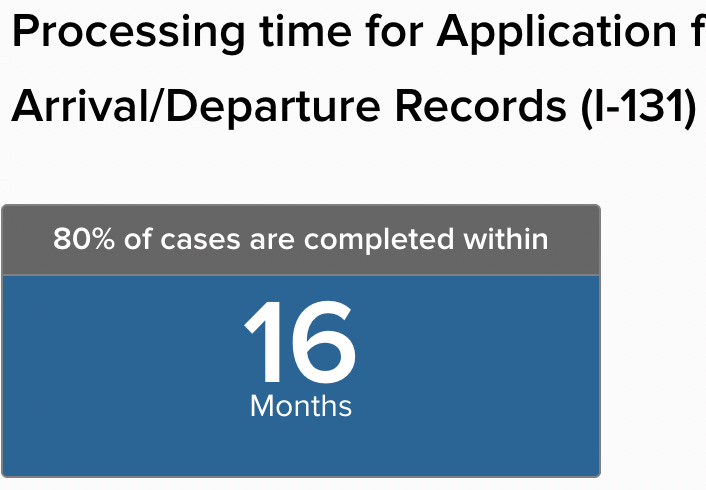 Screenshot — I-131 Re-Entry/Travel Document processing time, 16 months. Source: USCIS Processing Times (egov.uscis.gov/processing-times/), retrieved March 1, 2026.
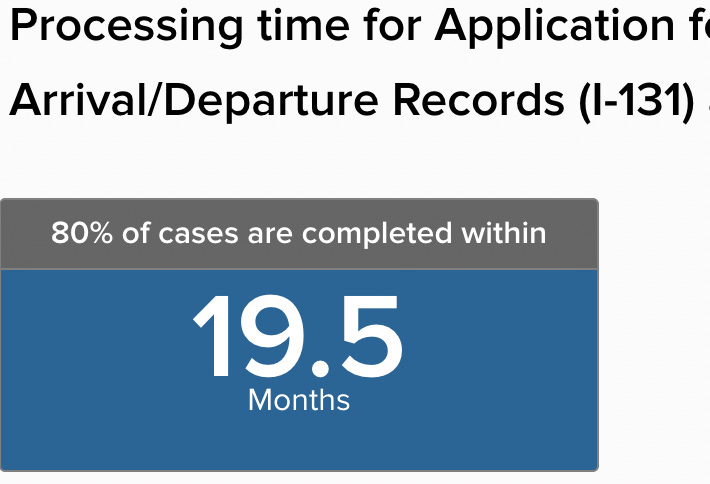 Screenshot — I-131 Advance Parole processing time, 19.5 months. Source: USCIS Processing Times (egov.uscis.gov/processing-times/), retrieved March 1, 2026.
The blanket asylum hold. PM-602-0192 paused adjudication of every pending asylum application before USCIS, for every nationality. As of this writing, the hold has not been lifted. More than one million affirmative asylum applications were pending before USCIS as of January 2025. They remain pending. No timeline. No criteria for completion. No findings from the purported review. Just silence. It’s the same silence applicants encounter when they try to use the administrative channels the government itself has provided. The $100,000 H-1B registration fee, for example, includes a waiver process — but requests submitted through that process have gone unanswered. The avenue exists on paper. The responses do not. This is why documenting every attempt to exhaust administrative remedies is key to any requestor’s immigration record: when the government offers a process and then refuses to operate it, that record becomes the foundation for compelling action in federal court.
Minnesota v. ICE. And when courts do order the government to act? On February 3, DHS attorney Julie Le appeared before U.S. District Judge Jerry Blackwell in St. Paul. Le — a DHS immigration court attorney who had volunteered for a detail to the U.S. Attorney’s office — had been assigned 88 cases in less than a month. She told the judge she had received no proper training from the Justice Department. She said getting DHS, ICE, and DOJ to comply with court orders was like “pulling teeth.” She asked the judge to hold her in contempt so she could get “a full 24 hours of sleep.” And then she said: “What do you want me to do? The system sucks. This job sucks. And I am trying every breath that I have so that I can get you what you need.” Judge Blackwell pointed to Chief U.S. District Judge Patrick Schiltz’s finding the previous week that ICE had violated court orders nearly 100 times across 74 cases in a single month. Le was fired the next day. Several prosecutors have since resigned from the Minnesota U.S. Attorney’s office.
The Department of Justice — the agency charged with upholding the rule of law — telling a federal judge it cannot comply with the law. This is not garden-variety bureaucratic delay. This is institutional incapacity that persists even under direct judicial supervision. And if the government cannot reliably follow a judge’s order in a case the judge is actively monitoring, the million-plus cases where no judge is watching have no safeguard at all.
Winning Battles, Losing Time
Courts, for their part, are pushing back — and finding, with increasing frequency, that the executive branch has acted unlawfully. To name a few:
These are real victories that provide real relief to real people, and the lawyers bringing these cases deserve credit, but the wheels of justice turn far more slowly than executive action moves. Even in strong cases brought before federal courts, the plenary power doctrine and Trump v. Hawaii give the executive branch enormous deference on entry restrictions. The Chamber of Commerce challenge to the $100,000 H-1B fee was decided in the government’s favor in December 2025, with the court citing the President’s “broad authority to regulate entry.” That decision is on appeal, with oral argument set for March 2026 — but it tells you something about the headwinds that immigration advocates face every day.
Where litigation has succeeded, it has generally been on procedural and administrative law grounds: arbitrary and capricious decision-making, failure to consider reliance interests, violations of notice-and-comment requirements. Important wins. But they’re rear-guard actions — correcting abuses after the fact rather than preventing the next one. And as the Minnesota transcript shows, even a court order is only as effective as the government’s willingness to follow it.
Meanwhile, the enforcement apparatus is funded at levels that make the shutdown largely symbolic. The One Big Beautiful Bill Act, signed in July 2025, allocated $75 billion to ICE alone — enough to sustain operations for years regardless of what Congress does with annual appropriations. The shutdown is a fight over accountability. The money is already out the door.
If you’re waiting for a court to fix this — or Congress — you might be waiting a long time. Litigation and legislation are tools in the toolbox. They are not a strategy by themselves.
Managing Uncertainty with Competent Advocacy
Not every immigration issue requires a lawyer. But there are specific moments in the current environment where having counsel meaningfully moves the needle — and where waiting for something to happen can close doors you didn’t know were open.
Here’s why that’s especially true right now: the overlapping restrictions described above have carved the immigrant population into dozens of distinct categories. Your situation depends on your country of birth, your nationality, your visa category, your priority date, when you filed, and which judicial district you’re in. Two people with identical qualifications and identical cases can face completely different outcomes based on a single variable. Generic guidance was never ideal. In this environment, it’s a liability.
Map the scenarios. Should you file now or wait? Consular processing or adjustment of status? Is it safe to travel? What happens if your EAD expires before the renewal is processed? In a system where delay is doing the work of policy, single-track strategies collapse quietly. An attorney’s value isn’t just knowing the law — it’s identifying every plausible path forward, ranking them by strength and risk, and helping you prepare for the scenarios you’d rather not think about. Sometimes that includes knowing when not to act — when restraint preserves more options than motion.
Push the case forward. Consular interview keeps getting canceled? USCIS won’t schedule you? There are procedural tools to move your case, but they require knowing what to ask for, where to send it, and persistence — escalating through administrative channels, congressional liaisons, or even pulling strings with personal connections, depending on the situation, until someone responds.
Qualify for an exemption. Both the Presidential Proclamations and the USCIS policy memoranda contain exceptions — for lawful permanent residents, certain visa categories, diplomatic personnel, and cases where a headquarters-level official determines that processing is in the national interest. These exemptions are narrow and discretionary, but they exist. If you don’t know to ask, the answer is always no.
Document everything. When the government offers a process and then refuses to operate it, the record you build — every unanswered request, every missed deadline, every exhausted administrative channel — becomes the foundation for compelling action later, whether through an ombudsman complaint, a congressional inquiry, or, if it comes to that, federal court, but you can’t get there or build the most compelling case without a robust and organized paper trail.
None of this makes the system fair, fast, or predictable — but it can keep you from being blindsided by it. USCIS has always had long processing times — that’s not new. What’s new is that many of the cases I’m tracking aren’t just slow. They’re stalled. Applications that should be moving aren’t, and the “enhanced review” the agency keeps citing has produced no published findings, no updated criteria, and no timeline for completion. If you’ve been reading this far, you already know the pattern: the administration isn’t consistently complying with federal court orders in cases judges are actively monitoring. The idea that they’re diligently working through your pending application in the background requires a level of faith that the documented record does not support.
Here’s the compounding problem: on December 4, 2025, USCIS slashed the maximum EAD validity period for asylum applicants from five years to eighteen months — meaning more people cycling through more costly renewals more often, hitting the same processing delays on each pass. The automatic extension, which used to give 540 days of continued work authorization while a renewal was pending, has been cut to 180 days or eliminated entirely for many categories, depending on when the application was filed. If USCIS takes eight months to process your renewal and your extension runs out at six, you’re looking at a work authorization gap with no safety net. You can’t work. Your employer can’t keep you on payroll. This isn’t limited to nationals of the 92 restricted countries — asylum applicants, EAD holders, adjustment cases, naturalization applicants, and even routine green card renewals are all more vulnerable than they were thirteen months ago. An attorney can assess whether your delay is the backlog or something requiring intervention.
What a Difference a Year Makes
What a year. Half the world is restricted from entering the U.S. A travel ban, a domestic freeze, a visa pause, and a blanket asylum hold — each under separate authority, none with a clear end date. Over a million TPS holders told to go home, regardless of the risks to life and safety. Over a million asylum applicants told to wait. A Department of Justice attorney telling a federal judge “the system sucks” and getting fired for it. Prosecutors resigning. Courts issuing orders the government declines to follow. Two U.S. citizens killed by federal agents. A government shut down — again — over whether those agents should wear body cameras. And a State of the Union address where the President asked for more.
What a month. What a week. What a Tuesday. What a weekend…
I started this firm because I believed people would need help navigating what was coming. Immigrants and expats interested in traveling to the U.S. or already here ought not wait for clarity. Clarity isn’t coming — not from the executive branch, and not reliably from the courts. The clients in the strongest position are the ones who identified what was within their control, made a plan, and acted on it. That’s what Jrada Immigration does. We help you figure out what’s within your control, map out the scenarios, and move forward. Not in fear. With a plan.