USCIS Adjudication Holds Ruled Unlawful
Today, a federal judge in Providence did something the other rulings this year had only gestured at. He didn’t vacate a policy for one family or one set of named plaintiffs. He took four of the government’s signature immigration holds, declared them unlawful, and blocked the USCIS from continuing its broadest nationwide adjudication holds.
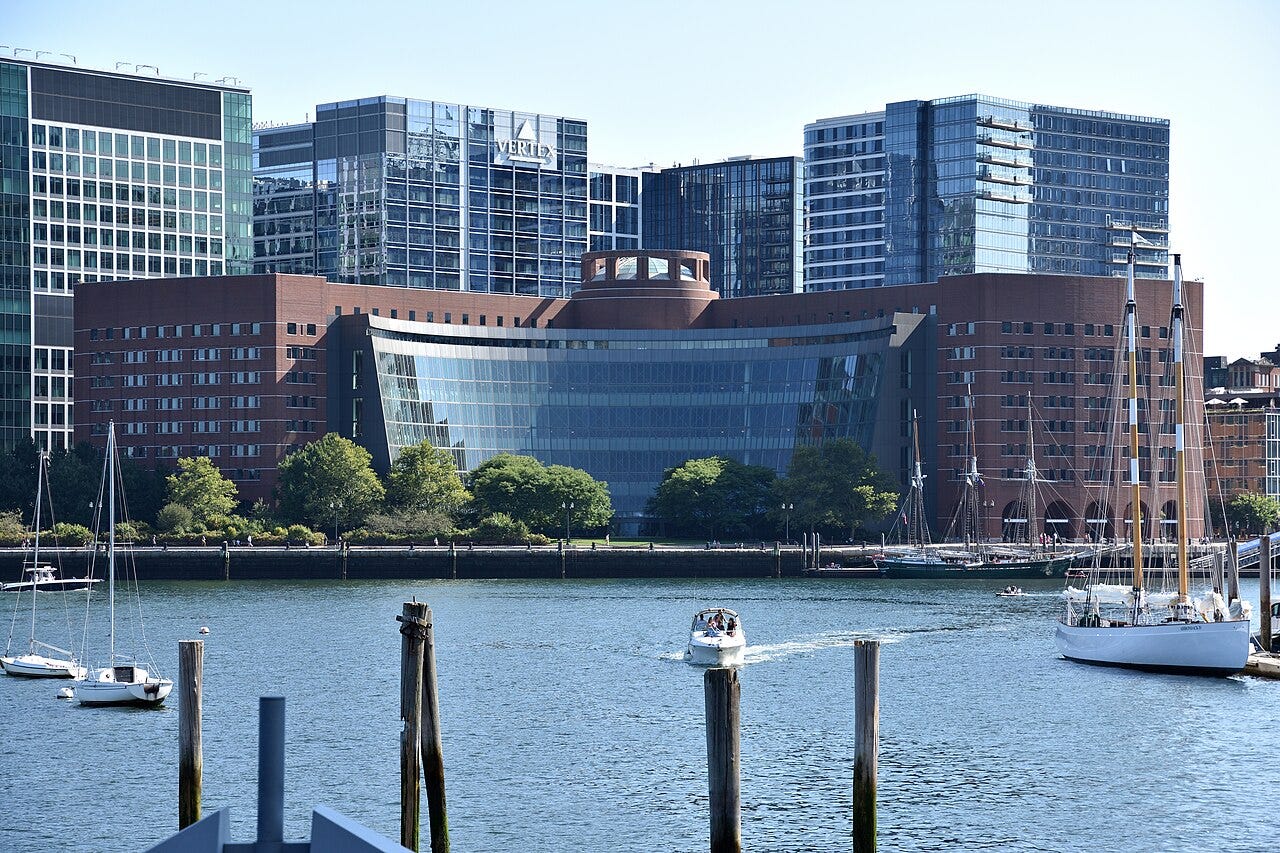 John Joseph Moakley United States Courthouse, Boston, Massachusetts
In Dorcas International Institute of Rhode Island v. USCIS, Chief Judge John J. McConnell Jr. granted summary judgment against the agency and set aside four policies in their entirety: the Benefits Hold, the Global Asylum Hold, the Comprehensive Re-Review of already-approved cases, and the Country-Specific Factors policy. Judge McConnell took the line everyone in this debate has heard a thousand times — that immigrants should “follow the law” and “do things the right way” — and pointed it back at the agency. These plaintiffs did follow the law, he found. They filed, they paid, they gave their biometrics, they showed up for their interviews. It was USCIS that had “neither ‘followed the law’ nor ‘done things the right way.’” Further, he noted that the national-security justifications the government offered were, in the court’s word, “pretextual” — cover for “anti-immigrant sentiments” the agency is forbidden from acting on. That is not a phrase a judge uses lightly, and it is not a phrase that travels well on appeal for the government.
If you’ve been reading this newsletter, and odds are you haven’t been lol, you know I built a map in attempt to keep track of it all, because no single agency announcement captured how many overlapping restrictions were landing on the same people at once. Today’s decision may have finally made a dent in the map-scape.
Two pauses, not one — and they’re not the same countries
There are two separate pauses, run by two different agencies, hitting two overlapping, but not identical, lists of countries.
The first is the State Department’s immigrant visa pause. Effective January 21, 2026, on the authority of a January 14 cable from Secretary Rubio, consular officers were told to refuse immigrant visas to nationals of 75 countries on the theory that they are at “high risk” of becoming a public charge. Visas, abroad. Issuance.
The second is the USCIS domestic hold — the one tied to the travel ban. This is the 40-jurisdiction list: the 39 countries, plus the West Bank and Gaza, that fall under the December travel ban proclamation. For people from those places already living here, USCIS simply stopped deciding most of their cases indefinitely.
The two lists overlap, but they are not the same, and the overlap is smaller than you’d think. Of the 75 on the visa-pause list and the 40 on the travel-ban list, 23 appear on both lists. That leaves 52 countries that are visa-pause only (no travel ban, no domestic hold) and 17 that are travel-ban only. So when people say “the 39 plus Palestine,” they’re describing the broad travel ban. When they say “the 75-country pause,” they’re describing a different, larger, partly-overlapping group. The map shows you exactly which bucket any country sits in.
Why the government lost
The courts have largely left alone the President’s role as bouncer at the main door into the USA. The President’s power to bar entry under INA § 212(f) is broad, and Trump v. Hawaii settled that fight in 2018. None of this year’s rulings touches it.
The government’s losses mainly touch on what the agencies did in addition to the 212(f) entry bans, the ones that implicate the people working through the very channels Congress built, precisely because they run contrary to established legislation.
The first basis for striking these policies down is acting beyond statutory authority. In Ullah v. LaFave (D. Mass., June 2), Judge Leo Sorokin found the visa pause likely unlawful because Secretary Rubio has no power to order consular officers to refuse visas they would otherwise grant. The statute hands the grant-or-refuse decision to the consular officer, individually, case by case; the Secretary’s own organic statute, INA § 104(a), carves that power out of his authority. Sorokin’s line is the one to remember: under the pause, “consular officers may apply the ordinary mechanisms of adjudication, but they are permitted to reach only one result: refusal.” A review that can only ever say no is not a review.
The second is the Administrative Procedure Act — the unglamorous workhorse of this whole fight. An agency cannot reverse course and freeze people’s lives without a reasoned explanation, and it cannot ignore the reliance interests of the people who structured their lives around the old rule. That’s the ground the Maryland court used in Saghafi v. Edlow (D. Md., April 24) to order USCIS to resume adjudicating 83 plaintiffs’ green-card applications, holding that while the substance of a decision is discretionary, the agency “does not have discretion to decide not to adjudicate at all.” It’s the ground Judge McConnell used today. And Saghafi wasn’t the first — it rested on a small cluster of district courts that had already reached the same conclusion on the same hold.
Today’s Dorcas ruling is the capstone: same logic, but nationwide relief instead of named-plaintiff relief.
Scope of rulings
Ullah protects exactly one person — Nur Ullah. The court declined to extend it further, so as a formal matter it lifts the pause for him and no one else. Its reasoning, though, is portable to any immigrant-visa applicant willing to file. The Nevada injunction earlier this year was similarly narrow — one family, an intercountry adoption case — but it was the first crack in the wall.
Today’s ruling in Dorcas is the broad one. Because Judge McConnell vacated the policies rather than merely enjoining them, the relief runs to everyone, not just the plaintiffs — which is also why he declined to issue an injunction at all. There was nothing left to enjoin.
Both Ullah and Dorcas are First Circuit cases, which will likely decide on the government’s requested stay on appeal, assuming DHS opts to appeal. A vacatur is harder to neutralize than an injunction: there’s no order to “stay,” so the government would have to persuade the First Circuit to undo the vacatur itself. And the First Circuit has already blessed exactly this remedy for unlawful agency guidance.1
This is, in other words, genuinely fluid. The holds are gone today. They may be partially back tomorrow if a stay is issued. That said, if you’re from one of the travel-ban countries and USCIS has been sitting on your case for asylum, EAD, green card, or naturalization, among others, Dorcas means that hold is, as of today, vacated nationwide.
If you’re an immigrant-visa applicant abroad from the public-charge list, the wins so far are mostly individual. The reasoning in Ullah supports filing your own APA or mandamus action, and the broader coalition case, CLINIC v. Rubio, is pending in the Southern District of New York as the vehicle most likely to deliver relief that isn’t person-by-person.
Notes
1 This isn’t a prediction about how the First Circuit will rule — it’s an observation that the remedy McConnell used (vacatur of unlawful agency action) is one the First Circuit has already endorsed. In the Dorcas opinion’s remedy section, the court cites two First Circuit authorities for it. The first is New York v. Trump, 171 F.4th 1, 30 (1st Cir. 2026), recognizing that “[i]f a district court decides that agency guidance violates the APA, it may vacate the guidance, preventing the agency from using it going forward” — though that line is itself the First Circuit quoting Justice Barrett’s concurrence in NIH v. American Public Health Ass’n, 145 S. Ct. 2658, 2662 n.1 (2025), so it’s the Circuit endorsing the principle rather than a holding squarely on these facts. The second, and cleaner, authority is Harrington v. Chao, 280 F.3d 50, 60 (1st Cir. 2002): “[V]acation is a proper remedy when an agency fails to explain its reasoning adequately” — an older First Circuit holding directly on point.